
NAD Injection Dosage Per Day
What a daily NAD injection dose actually means, how programs structure it across loading and maintenance phases, and what ranges providers typically prescribe.
What "Dosage Per Day" Actually Means
Most NAD injection programs are not dosed every single day. When providers talk about NAD injection dosage per day, they typically mean the effective daily average across a weekly schedule — not a literal daily injection.
For example, someone injecting 500mg three times per week is averaging roughly 214mg per day of effective NAD — concentrated into three sessions rather than spread evenly across seven days.
This distinction matters when comparing programs: a "500mg program" and a "200mg daily dose program" may be describing the same underlying protocol, just expressed differently. Understanding this helps you compare providers accurately instead of assuming a lower-sounding number means a weaker program.
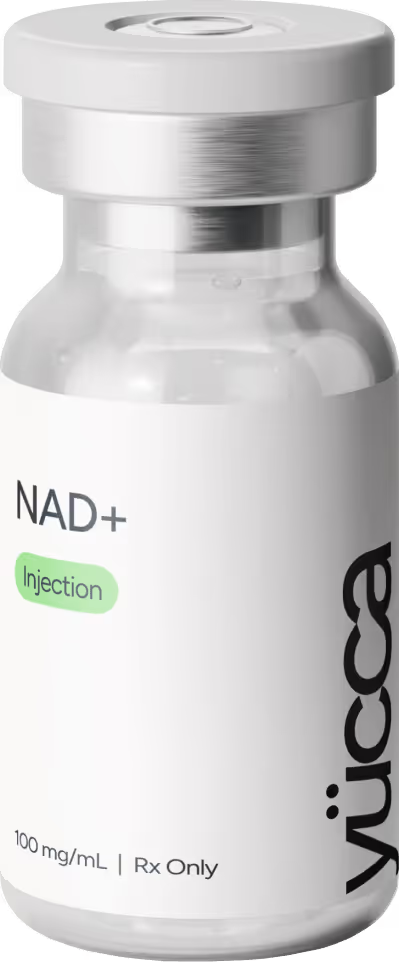
Yucca Health NAD+ Injections
Personalized NAD+ injection program with a licensed U.S. provider, transparent monthly pricing, and free 2-day shipping. Includes a patient portal for treatment management and ongoing provider guidance.
System Labs NAD+ Injections
Physician-guided NAD+ program with online eligibility review, licensed provider oversight, and home delivery for eligible patients.
EnhanceMD NAD+ Injections
Guided NAD+ program with personalized treatment recommendations, licensed provider oversight, and convenient home delivery.
Per Day vs. Per Week: Doing the Math
To convert any NAD injection protocol into a daily average, multiply the per-injection dose by the number of injections per week, then divide by seven. A few common examples:
250mg, twice weekly — 500mg total per week, roughly 71mg per day.
500mg, three times weekly — 1,500mg total per week, roughly 214mg per day.
1,000mg, once weekly — 1,000mg total per week, roughly 143mg per day.
Notice the last two examples land in a similar daily-average range despite very different single-dose sizes. This is why comparing programs by "dose per injection" alone can be misleading — the frequency matters just as much as the milligram count. For a full breakdown of dosing tiers, see our full dosage chart and guide.
500mg NAD Injection Dosage Per Day, Explained
500mg is one of the most commonly prescribed single-injection doses in structured NAD programs, making it worth breaking down on its own. At three injections per week, 500mg produces an effective daily average of about 214mg — placing it solidly in the standard loading range.
At a reduced frequency of once weekly, that same 500mg dose only averages roughly 71mg per day — closer to a light maintenance protocol despite using an identical per-injection amount. This is why your provider's frequency recommendation matters just as much as the milligram strength they prescribe.
Most people on a 500mg protocol are in the loading phase, working to rapidly replenish depleted cellular NAD stores before transitioning to a lighter maintenance schedule once baseline levels are restored.
Why Daily NAD Injections Aren't Standard Practice
It's a common assumption that more frequent injections mean faster or better results, but structured NAD programs rarely prescribe literal daily injections — and there are practical reasons why.
A single NAD injection typically produces measurable cellular effects lasting three to seven days. Injecting again before that window closes doesn't meaningfully accelerate results — it primarily increases injection site irritation and medication cost without proportional benefit.
Spacing injections two to three days apart, as most loading protocols do, allows each dose to be fully utilized by the body before the next one arrives — which is a more efficient use of both the medication and your injection sites. See our full injection site guide for rotation technique.
What Determines Your NAD Injection Dose Per Day
Baseline depletion. More severe depletion typically calls for a higher starting dose during loading — more NAD to replenish means a higher effective daily average early in treatment.
Treatment goal. Chronic fatigue or post-viral recovery often requires a higher effective daily dose than longevity-focused maintenance use.
Metabolism and body weight. Faster metabolic rates may require more frequent dosing to maintain elevated NAD levels between injections — effectively raising the daily average needed to sustain results.
Phase of treatment. Loading phase daily averages are always higher than maintenance — the goal during loading is rapid cellular replenishment, while maintenance is sustaining levels already established.
Signs Your NAD Dosage Per Day May Need Adjusting
If you've completed a full loading phase and aren't seeing the results you expected, the daily average dose — not just the number on the syringe — is often the first thing worth reviewing with your provider.
Minimal or no noticeable change after 2-3 weeks — may indicate the effective daily dose is too low for your baseline depletion.
Results that fade quickly between sessions — often points to injection frequency being too spread out relative to your dose size.
Never adjust your dosage or frequency without provider guidance — a quality program will review your response and adjust your protocol accordingly rather than leaving you to self-titrate. See our evidence and reviews guide for what real users report about dosing outcomes.